
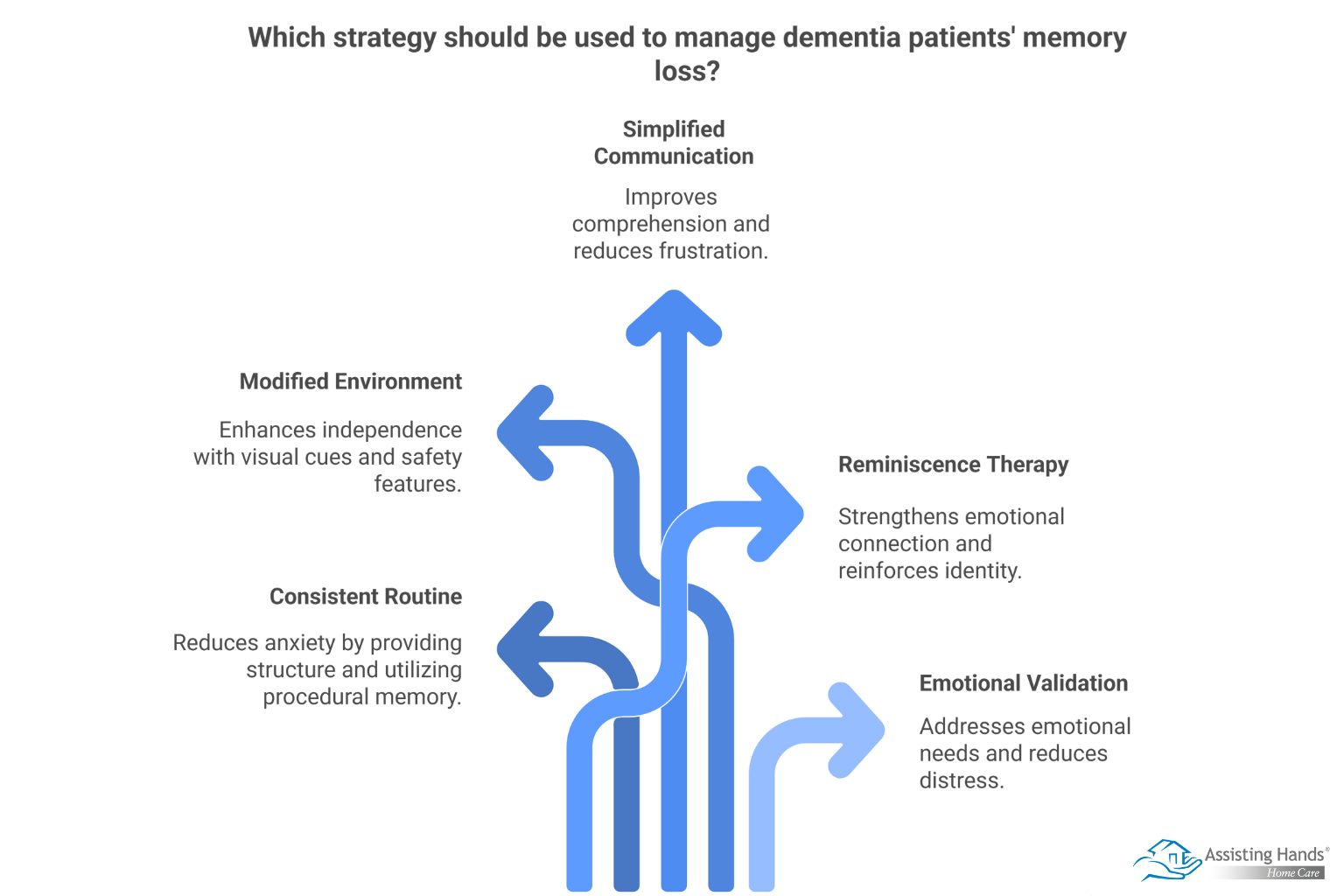
Helping a dementia patient cope with memory loss generally involves creating structure, simplifying communication, and adapting the environment to reduce confusion. Most effective strategies focus on routine, visual cues, emotional validation, and meaningful engagement to support daily functioning and ease anxiety.
Watching a senior loved one face challenges with fading memories is one of the most heart-wrenching aspects of dementia care. While you cannot reverse the progression of the disease, implementing specific strategies can significantly reduce your loved one’s anxiety and enhance his or her daily quality of life.
Why Does a Consistent Daily Routine Reduce Anxiety in Dementia Patients?
A consistent routine can reduce stress by giving structure to days that may otherwise feel confusing or unpredictable. Repetition allows daily tasks to be stored in procedural memory, which often remains intact longer than short-term recall.
Uncertainty is a major source of stress for individuals experiencing memory loss. When the world feels confusing, a predictable routine serves as an anchor, providing a sense of safety and structure. By performing tasks at the same time each day—such as bathing, dressing, and eating meals—you ingrain these activities into your loved one’s remaining procedural memory.
Try to build this routine around your loved one’s preexisting habits. If your loved one was always an early riser, schedule important activities for the morning when he or she is most alert. Keep the schedule visible on a large whiteboard or calendar, marking off days and events clearly. This visual reinforcement can ground your loved one in time, reducing the repetitive questions about what’s happening next.
If your loved one is living with dementia, having a trained professional caregiver close by can provide you and your family with much-needed peace of mind. One of the most challenging tasks of helping an elderly relative age in place safely and comfortably is researching agencies that provide home care. Families can turn to Assisting Hands Home Care Potomac for reliable, high-quality elder care for aging adults. We offer 24-hour care for seniors who require extensive assistance, and we also offer respite care for family caregivers who need a break from their caregiving duties.
How Should You Modify the Home Environment to Support Independence?
A well-organized environment reduces cognitive overload and helps a dementia patient navigate daily tasks with fewer prompts. Visual cues replace the need for recall, allowing your loved one to function more independently.
A cluttered or disorganized environment can overstimulate a brain already having difficulty processing information. Modifying the living space to include clear visual cues can drastically increase independence and reduce frustration. The goal is to make the environment intuitive so your loved one doesn’t have to rely solely on recall to navigate the day.
Consider implementing these environmental changes:
- Labeling – Place clear, easy-to-read labels or pictures on drawers and cupboards indicating what’s inside (e.g., “Socks,” “Cups”).
- Signage – Use signs for important rooms like the bathroom or bedroom, keeping doors open when possible to provide visual access.
- Safety cues – Use contrasting colors to highlight steps or handrails, making them easier to see.
- Memory aids – Keep essential items like glasses, keys, or the remote control in the exact same spot every day.
What Communication Techniques Make Conversations Easier for Dementia Patients?
Clear, simplified communication reduces frustration and supports comprehension when language processing slows. Limiting choices and breaking instructions into steps makes conversations more manageable.
As memory fades, language processing often slows down. Complex sentences or open-ended questions can feel overwhelming, leading to agitation or withdrawal. Adjusting how you speak can make interactions smoother and less taxing for your loved one.
When communicating, maintain eye contact and speak slowly and clearly. Break down instructions into single manageable steps. Instead of asking “What would you like for lunch?” which requires your loved one to scan his or her memory for options, try asking “Would you like a sandwich or soup?” This limits the choices and makes decision-making easier. If your loved one has difficulty finding a word, patiently offer a suggestion or simply acknowledge the emotion behind what he or she is trying to say rather than correcting the facts.
How Does Reminiscence Therapy Support Emotional Wellbeing?
Reminiscence therapy strengthens emotional connection by engaging long-term memories that often remain accessible. Familiar sights, sounds, and activities reinforce identity and comfort.
Short-term memory is often the first to deteriorate in dementia patients, while long-term memories remain intact for much longer. Tapping into these older memories can be a powerful way to connect and validate your loved one’s identity. Reminiscence therapy involves discussing past activities, events, and experiences, usually with the aid of tangible prompts.
You can facilitate this by:
- Looking through photo albums – Focus on photos from your loved one’s childhood or early adulthood.
- Playing familiar music – Songs from your loved one’s youth may trigger strong positive emotional responses and memories.
- Tactile prompts – Handling objects related to your loved one’s past career or hobbies (like knitting needles or carpentry tools) can spark conversation.
- Cooking familiar recipes – The smell and taste of a favorite family dish can be incredibly evocative.
A professional caregiver can help your loved one enjoy cognitively stimulating activities such as exploring a memory box or naming people and places in old photos. Certain age-related conditions can make it more challenging for older adults to age in place safely and comfortably, but experts in 24-hour care for Potomac seniors are available around the clock to help aging adults manage their health. Whether your loved one is living with dementia or recovering from a stroke, you can trust the professional caregivers from Assisting Hands Home Care to enhance his or her quality of life.
Why Is Validating Emotions More Helpful than Correcting Facts?
Validation reduces distress by addressing emotional needs rather than challenging perceived reality. Correcting factual errors often increases confusion and anxiety.
One of the most difficult challenges for caregivers is handling false realities. Your loved one might insist he or she needs to go to work (even if he or she retired decades ago) or ask for a deceased parent. In these moments, correcting your loved one with facts (“Mom died ten years ago”) could cause fresh grief and confusion.
Instead, practice validation therapy. Step into your loved one’s reality and address the emotion driving the behavior. If your loved one is asking for his or her mother, he or she may be feeling insecure or lonely. You might say “You really miss your mom, don’t you? She was a wonderful cook. Tell me about her Sunday roasts.” This approach validates your loved one’s feelings and redirects the anxiety without causing distress over forgotten facts.
Frequently Asked Questions
Should I correct my loved one when he or she recalls events incorrectly?
No. Correcting false memories often causes distress and accomplishes nothing therapeutic. Instead, validate the emotion behind the statement and gently redirect the conversation to maintain connection without confrontation.
What time of day is best for important activities with dementia patients?
Generally, morning hours work best when cognitive function tends to be strongest. However, align activities with your loved one’s lifelong patterns. If your loved one was always a night person, respect that rhythm when possible.
Can dementia patients still form new memories at all?
Sometimes, but rarely. While short-term memory is severely compromised, emotional memories and procedural learning (like daily routines) can still develop through consistent repetition and positive experiences.
How do I handle repetitive questions without losing patience?
Answer each time as if hearing it for the first time, keeping responses brief and reassuring. Remember your loved one isn’t asking to annoy you—he or she genuinely doesn’t remember asking before.
Is reminiscence therapy appropriate at all stages of dementia?
Often yes. Long-term memories typically remain accessible longer than recent ones.
Aging in place can present a few challenges for seniors living with dementia. However, with professional dementia care that offers Potomac families peace of mind, they can still live independently at home. Families can rely on Assisting Hands Home Care to provide their elderly loved ones with mental and social stimulation, timely medication reminders, assistance with meal prep, and much more. Our caregivers are available around the clock to help your loved one live a happier and healthier life. To hire a professionally trained caregiver for your loved one, call us today.