
Repetitive questioning is a common and often challenging behavior associated with dementia. Understanding the reasons behind it and learning effective coping strategies can greatly enhance the quality of care for a senior loved one with dementia. This article offers practical tips for managing this behavior with patience and compassion.
Understand the Cause of the Questions
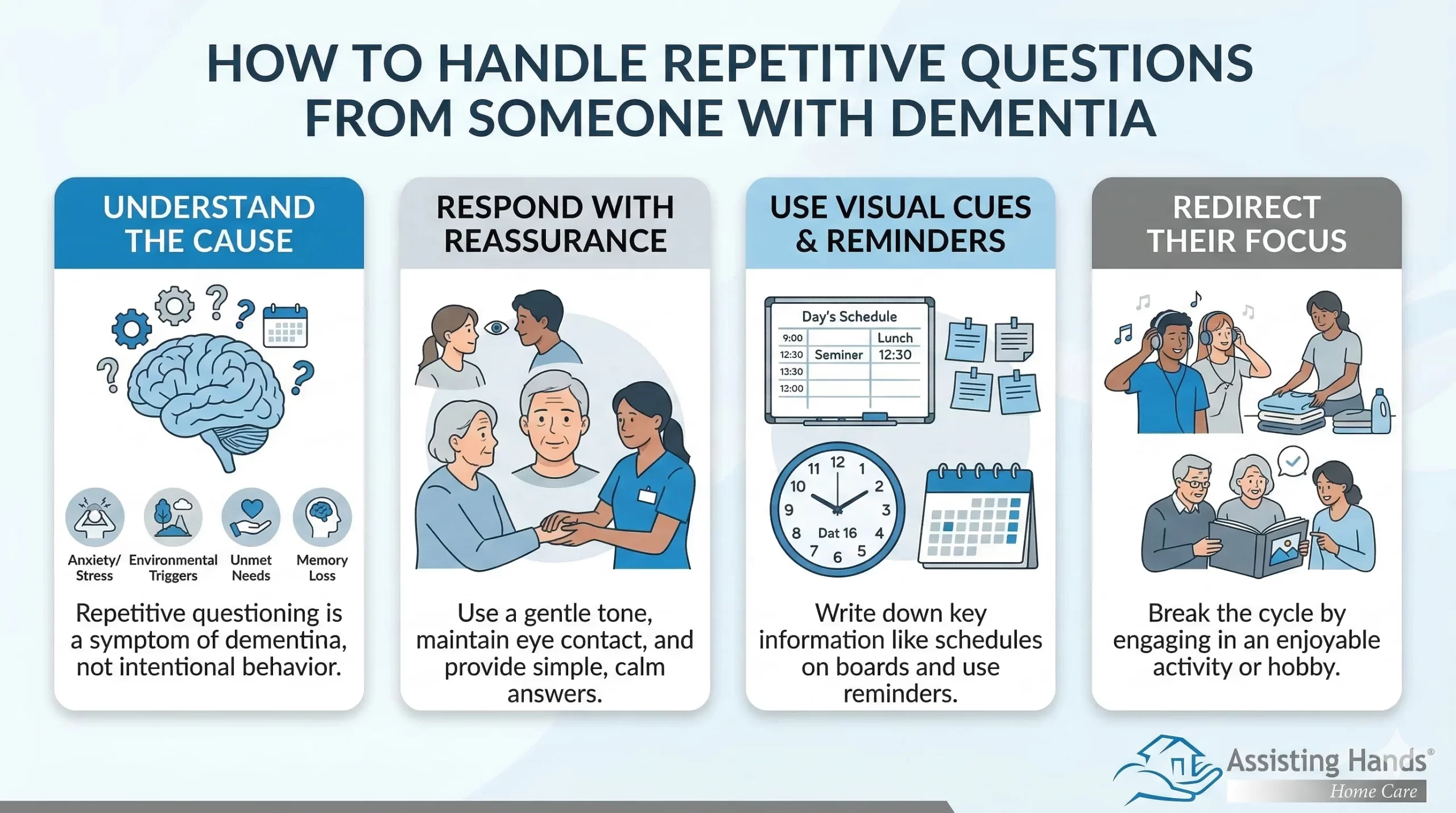
Repetitive questioning in dementia isn’t intentional. It’s a symptom of the disease’s impact on the brain. Memory loss is the most obvious cause. Your loved one may genuinely not remember asking the question or hearing the answer you just provided. However, other factors can also contribute to this behavior. These include:
- Anxiety or stress – Your loved one may be feeling worried, insecure, or anxious. The question your loved one is asking might be his or her way of seeking reassurance or comfort.
- Environmental triggers – Something in your loved one’s surroundings, like a TV show or an upcoming appointment on a calendar, might be prompting the same question repeatedly.
- Unmet needs – Your loved one could be trying to communicate a basic need, such as hunger, thirst, or the need to use the restroom, but is unable to express it directly.
A professional caregiver with experience in caring for seniors with dementia can be a wonderful source of support for your whole family. Whether you need respite from your caregiving duties or your aging loved one needs 24-hour care in Potomac, Assisting Hands Home Care can meet your family’s care needs. Our dedicated caregivers are available around the clock to provide transportation to doctor’s appointments, ensure seniors take their prescribed medications, and help with a variety of tasks in and outside the home.
Respond with Calm and Reassurance
Your reaction can significantly influence the situation. Responding with frustration or irritation could increase your loved one’s anxiety, potentially making the repetition worse. Instead, try to remain calm and patient. When you answer, use a gentle and reassuring tone of voice. Even if you’ve answered the same question multiple times, respond as if it’s the first time you’ve heard it. Simple, direct answers are often more effective than long, complicated explanations that can be difficult to process. Making eye contact and offering a comforting touch, such as holding your loved one’s hand, can also convey you’re there and that everything’s okay.
Caring for seniors with dementia can be challenging for family caregivers. Luckily, there is dementia care Potomac families can rely on. Professional dementia caregivers help seniors with dementia stay safe and comfortable at home by preventing wandering, providing cognitive stimulation, and assisting with household chores.
Use Visual Cues and Reminders
Since verbal information can be quickly forgotten, visual aids can be incredibly helpful. These tools provide a constant, accessible source of information that can reduce the need for repeated questions.
Consider these strategies:
- Whiteboards or memo boards – Write down key information in a central location. This could include the day’s schedule, answers to common questions (e.g., “Lunch is at 12:30 p.m.”), or reminders about upcoming events.
- Sticky notes – Place notes around the house as reminders. For example, a note on the front door that says “We’re going for a walk at 3 p.m.” can answer the question of what’s happening next.
- Clocks and calendars – Large, easy-to-read clocks that display the date, day of the week, and time can orient your loved one and reduce confusion.
Redirect Your Loved One’s Attention
Sometimes, the most effective strategy is to gently redirect your loved one’s focus to a different activity. This can break the cycle of repetitive questioning by engaging your loved one’s mind in a new and pleasant way.
Look for an activity your loved one enjoys and finds meaningful. You could suggest:
- Listening to favorite music
- Looking through old photo albums together
- Engaging in a simple hobby like folding laundry or sorting objects
- Going for a short walk
By shifting your loved one’s attention to something enjoyable, you can move him or her away from the thought loop causing the repetitive questions. It provides a positive distraction and a new point of focus.
Sometimes family caregivers find it challenging to address dementia symptoms in their loved ones, and professional caregivers can help. Families looking for top-rated Potomac senior home care providers can reach out to Assisting Hands Home Care. From respite care to specialized Alzheimer’s, dementia, stroke, and Parkinson’s care, there are many ways we can make life easier for seniors and their loved ones. To learn about our high-quality in-home care services, give us a call today.